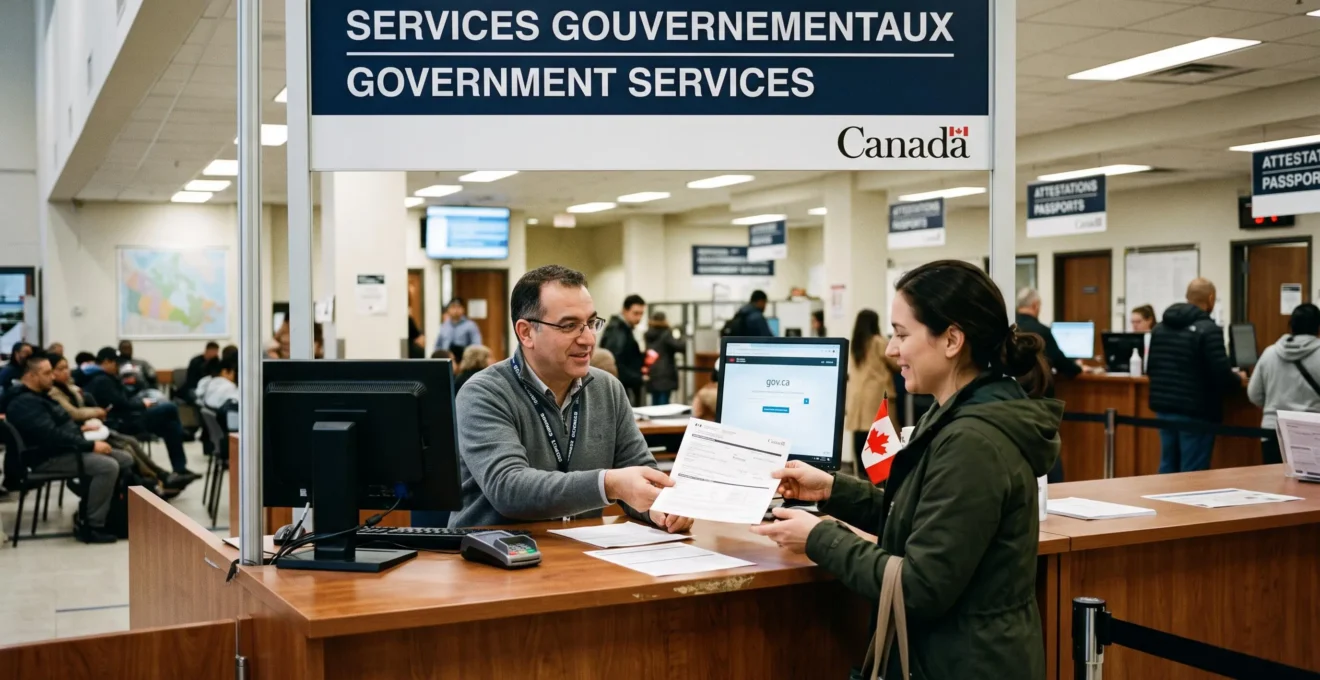
In Canada, French and English share official status at the federal level, but their role in everyday life varies considerably across provinces, cities, and institutions. Someone living in Montreal, Moncton, or Calgary will not necessarily encounter the same language rules or have the same opportunities to use French when dealing with public services.
This duality is reflected in public services, education, businesses, the job market, and culture. It is based on constitutional guarantees, federal laws, and provincial legislation that pursue sometimes different objectives: ensuring the equal institutional status of the official languages, protecting minority communities, and preserving the position of French.
Understanding how this system works therefore requires distinguishing between language rights, people’s everyday practices, and the obligations of each level of government. Canada is officially bilingual, but this does not mean that all its residents are required to be bilingual.
Canada’s linguistic duality at a glance
- French and English are the two official languages of federal institutions, but each province has its own language framework.
- Quebec prioritizes French, New Brunswick officially recognizes both languages, and Ontario protects access to certain services in French.
- According to the 2021 Census, 18.0% of Canada’s population could hold a conversation in both official languages.
- Why does Canada officially recognize French and English?
- How can you determine which language to use depending on where you live in Canada?
- Quebec, New Brunswick, or Ontario: how does the presence of French vary?
- Why doesn’t Canada’s official bilingualism mean that every Canadian speaks two languages?
- When can bilingualism expand employment opportunities in Canada?
- How is French used in workplaces, shops, and services in Quebec?
- Why are public responsibilities shared between different levels of government?
- How does Canada’s national heritage reflect its historical and cultural diversity?
Why does Canada officially recognize French and English?
Canada officially recognizes French and English to guarantee their equal status within federal institutions and protect the rights of their linguistic communities. This recognition stems from a political history shaped by the coexistence of French-speaking and English-speaking populations, followed by the adoption of constitutional and legislative safeguards. It does not mean that all residents must be proficient in both languages.
The Constitution Act, 1867, already provided for rights relating to the use of French and English in the federal Parliament, before certain courts, and in Quebec institutions. However, it did not establish a general bilingualism framework applicable to all Canadian administrations.
The Official Languages Act of 1969 subsequently marked a major milestone in the institutional recognition of both languages. Adopted amid linguistic tensions and growing demands for language rights, it helped establish federal obligations regarding communications and services.
The Canadian Charter of Rights and Freedoms, incorporated into the Constitution in 1982, establishes in Section 16 the equal status of French and English in the institutions of Parliament and the Government of Canada. The following sections specify certain rights, particularly regarding court proceedings, parliamentary proceedings, and communications with public institutions.
The text of Canada’s constitutional acts, published by the Department of Justice, makes it possible to distinguish between these different guarantees.
In particular, two separate concepts must be distinguished:
- Institutional bilingualism imposes obligations on certain public institutions regarding the use of both official languages.
- Individual language rights allow people to communicate with these institutions or obtain certain services in their official language, subject to applicable conditions.
New Brunswick holds a special position: Section 16 of the Charter also recognizes both languages as official in this province, while Section 16.1 protects the equality of its French-speaking and English-speaking linguistic communities.
This legal framework is therefore the result of a federal compromise that takes into account different historical and demographic circumstances.
The official status of French and English thus provides a common framework, but its practical application depends on the institution and the location of the person concerned.
How can you determine which language to use depending on where you live in Canada?
To determine which language to use in Canada, you need to consider the region’s majority language, provincial regulations, and the services available in the minority official language. French generally plays a central role in Quebec, while English dominates in many other provinces. However, federal services may offer both languages even in predominantly English-speaking regions.
Three questions can help you understand the local situation: which language is most commonly used in everyday interactions, what obligations apply to the organizations concerned, and what services are available to the minority linguistic community?
These factors do not necessarily overlap. A predominantly English-speaking city may have a French-language school, French-speaking community organizations, or a bilingual federal office. Conversely, the presence of a French-speaking population does not guarantee that every private business offers services in French.
The framework also varies depending on the level of government:
- In Quebec, French is the official and common language, with specific obligations for businesses and public organizations.
- In Ontario, French-language provincial services are guaranteed within the scope of Ontario’s legislation.
- In Manitoba, certain constitutional rights apply particularly to legislative and judicial institutions, but this does not automatically make all provincial services bilingual.
- In Alberta, English predominates in provincial services, despite the presence of French-speaking communities and services.
Different rules apply to federal institutions. Head offices and central administrations must notably provide services in both languages. Other offices are subject to this obligation depending on criteria such as their location, language demand, or specific mandate.
The Treasury Board’s page on bilingual federal offices outlines the main designation criteria.
It is therefore not enough to establish that a service falls under federal jurisdiction to assume that all its service counters are subject to the same requirements.
How to check which language to use in your region
- Identify your province and municipality of residence, then note the majority language used in local services.
- Determine whether the service you need falls under federal, provincial, or municipal jurisdiction and record this information.
- Check the language rules applicable to the organization concerned and make a short list of the rights you are entitled to.
- Verify which languages are offered by the specific office or service and save the reference to its official information page.
- Prepare your request in the available language or ask how to access the service in the other official language, then record the response you receive.
The determining factor remains the combination of location, the organization’s status, and the applicable rights: a provincial border alone does not capture the full picture of the local linguistic situation.
Quebec, New Brunswick, or Ontario: how does the presence of French vary?
French holds very different positions in these three provinces. In Quebec, it is the sole official language and the common language. In New Brunswick, it shares official status with English in provincial institutions. In Ontario, it benefits from specific protections, particularly for certain public services and education, although the province does not have the same official bilingualism framework as New Brunswick.
These legal distinctions are reflected in everyday life, but they are not enough to measure the actual presence of French. The geographical distribution of communities, schools, media, and local services also plays an essential role.
| Province | Status and protections | Presence of French |
|---|---|---|
| Quebec | French is the sole official language and the common language | Dominant language in many institutions, economic activities, and public communications |
| New Brunswick | French and English are officially recognized as equal languages in provincial institutions | Strong presence in Acadian communities, with varying local circumstances |
| Ontario | Specific protections for French-language services and minority-language education | Significant communities, particularly in the eastern and northern parts of the province |
According to data from the 2021 Census, French was the first official language spoken by 82.2% of Quebec’s population, 30.0% of New Brunswick’s population, and 3.4% of Ontario’s population. These figures measure a specific linguistic indicator, distinct from mother tongue or the language used exclusively at home.
Statistics Canada’s 2021 Census language results also show that the proportion of people whose first official language spoken was French declined nationwide between 2016 and 2021.
Outside Quebec, this proportion fell from 3.6% to 3.3%. A declining percentage does not necessarily mean that the absolute number of French speakers is decreasing, but it illustrates the challenges involved in maintaining their relative demographic weight.
In the Ottawa-Gatineau region, both languages coexist visibly, while Acadia in New Brunswick and Saint-Boniface in Manitoba reflect the historical roots of French outside Quebec.
French-language schools, post-secondary institutions such as the Université de Moncton and the University of Ottawa, as well as cultural and community organizations, help pass the language on to future generations. The right to education in the minority official language, governed by Section 23 of the Canadian Charter, provides an important safeguard, although it is subject to specific eligibility criteria.
The continued existence of these institutions depends in particular on demographic conditions, public policies, and available resources. This is why the language issue goes beyond mere legal recognition.
These regional differences also explain why individuals’ ability to speak both languages remains highly unequal across Canadian regions.
Why doesn’t Canada’s official bilingualism mean that every Canadian speaks two languages?
Canada’s official bilingualism primarily applies to federal public institutions, not to the language skills of every citizen. There is no general requirement for Canadians to speak both French and English. According to the 2021 Census, only 18.0% of the population reported being able to hold a conversation in both official languages.
This distinction is fundamental: a country with two official languages is not necessarily a society in which most people are bilingual. The government must comply with certain language obligations, while individuals use the languages they know in their personal and professional lives.
18.0%
Share of Canada’s population able to hold a conversation in French and English, according to the 2021 Census. This self-reported indicator does not measure certified professional proficiency.
Statistics Canada, 2021 Census of Population.
Personal bilingualism rates vary considerably across regions. In 2021, 46.4% of Quebec residents reported being able to converse in both official languages, compared with 9.5% of people living elsewhere in Canada.
This difference can be explained in particular by the linguistic environment. In a province where French is the majority language, learning English can facilitate interactions with the rest of the country and North America. In a predominantly English-speaking region, everyday opportunities to use French may be more limited.
French speakers are therefore proportionally more likely to also speak English than English speakers are to speak French. This imbalance reflects, among other things, the minority position of French across North America.
Statistics Canada data also show that the national French-English bilingualism rate experienced a slight decline between 2016 and 2021. It would therefore be inaccurate to assume that official recognition of both languages automatically leads to continuous growth in individual bilingualism.
Furthermore, Canada’s linguistic diversity extends far beyond French and English. Indigenous languages and languages brought by immigrants are present in families, neighborhoods, businesses, cultural activities, and certain community services.
Someone may therefore be bilingual in English and Punjabi, or in French and an Indigenous language, without being counted as French-English bilingual in the corresponding statistics.
This distinction also has practical implications for employment: speaking both official languages can be a sought-after qualification, but only in certain occupations and professional environments.
When can bilingualism expand employment opportunities in Canada?
Proficiency in French and English can expand employment opportunities in Canada when a position involves communicating with both linguistic communities. This advantage is particularly relevant in the federal public service, customer service, education, media, and organizations operating in several provinces. However, its importance depends on the position, industry, and workplace location.
In some fields, bilingualism provides a competitive advantage. In others, it may be a formal requirement for accessing a position.
The federal public service illustrates this distinction. Certain positions are designated bilingual because their holders must perform duties in both official languages. Language requirements are defined according to the actual responsibilities associated with each position.
For these positions, language skills may be assessed separately across three areas:
- Reading comprehension, to read professional documents in the other official language.
- Written expression, to draft messages, reports, or administrative communications.
- Oral proficiency, to understand and communicate in professional interactions.
Language profiles for federal positions may use levels A, B, and C for the relevant skills. The specific requirements should be checked in each job posting.
It is also important to distinguish between imperative appointments, where candidates must meet the language requirements at the time specified for appointment, and certain non-imperative appointments, which allow candidates to acquire the required skills under applicable conditions.
Outside the public service, bilingualism may be valued by businesses serving both French-speaking and English-speaking markets, including financial services, tourism, transportation, communications, interprovincial trade, and institutional relations.
In French-language education and services aimed at minority communities, knowledge of French can meet essential communication, language transmission, and support needs.
Quebec has a particular context. Given the official status of French and the province’s language legislation, employers must comply with specific requirements concerning the language used at work. Knowledge of French can therefore be essential for accessing many jobs.
The Charter of the French Language also regulates the circumstances in which an employer may require knowledge of a language other than French. Such a requirement must comply with the conditions set out in the applicable legislation.
To assess the professional value of bilingualism, it is better to compare the requirements of several job postings for the same occupation rather than assume that speaking a second language guarantees higher pay.
In Quebec, the relationship between language and employment is part of a broader framework that also governs internal business communications and interactions with consumers.
How is French used in workplaces, shops, and services in Quebec?
In Quebec, French is the official and common language of public life. The Charter of the French Language governs its use in workplaces, shops, and many services. Employees benefit from language protections, while businesses must comply with requirements relating to documents, signage, and communications with consumers, subject to applicable exceptions.
Quebec’s legislation notably aims to enable people to work, shop, and carry out administrative procedures in French.
Legislative amendments adopted in 2022, particularly under Bill 96, strengthened several provisions concerning the role of French. However, their application varies according to business activities, organizational size, and specific regulatory frameworks.
In the workplace, the Charter protects employees’ right to carry out their duties in French. It also establishes rules concerning work-related documents, certain employer communications, and recruitment practices.
Section 45.1 notably protects employees against certain forms of discrimination or harassment related to their knowledge or use of the official language. Section 46, for its part, governs the circumstances in which knowledge of another language may be required to obtain or retain a job.
Businesses subject to French-language compliance requirements must also implement the measures prescribed by law. The specific requirements depend in particular on their workforce size and individual circumstances.
In shops, French appears on products, packaging, information documents, and signs intended for the public. Regulations provide specific arrangements for certain elements, particularly trademarks.
A trademark displayed in another language is therefore not necessarily prohibited, but its use may be subject to certain conditions. It would be equally inaccurate to assume that a foreign trademark automatically allows French to be omitted from signage or commercial information.
The Charter of the French Language, published by Quebec’s official publisher, outlines these obligations in its version dated June 6, 2025. For a specific legal situation, the applicable version on the relevant date and the corresponding regulations should be checked.
French also plays a central role in Quebec’s public services. However, certain circumstances provide for the possibility or requirement to communicate in another language, particularly depending on the organization’s status and applicable legal exceptions.
The Office québécois de la langue française plays a role in enforcing the Charter, supporting businesses with French-language compliance, and handling reports within its jurisdiction. Employee complaints may also fall under the protection mechanisms applicable under employment law.
Finally, businesses under federal jurisdiction may be subject to specific rules. A bank or telecommunications company, for example, should not automatically be treated as a business governed exclusively by provincial law.
This coexistence of provincial and federal rules shows why language responsibilities cannot be assigned to a single level of government.
Why are public responsibilities shared between different levels of government?
Language responsibilities are distributed across different levels of government because Canada is a federation. The Constitution assigns separate powers to the federal Parliament and the provinces, particularly in areas such as public administration, education, and economic regulation. Language rights are part of this system, which explains why different rules apply depending on the institution and location.
The federal government must comply with constitutional and legislative provisions governing its own institutions. Provinces, in turn, have significant powers to organize their school systems, administrations, and many activities falling within their jurisdiction.
Several levels of rules can therefore complement or interact with one another:
- The constitutional framework protects certain fundamental language rights, particularly within federal institutions, in New Brunswick, and in minority official-language education.
- Federal legislation specifies the obligations of many institutions under the Government of Canada.
- Provincial laws determine a significant part of the conditions governing language use in public services, the workplace, and economic life.
- Municipal administrations carry out their duties within the framework of the powers and obligations assigned to them by their province.
This division explains why an administrative procedure involving a federal agency may follow different language rules from one involving a provincial ministry located in the same city.
It can also raise complex questions concerning commercial signage, employee communications, or federally regulated businesses operating in Quebec.
Education is another important area. Provinces organize their school systems, but they must comply with the applicable constitutional guarantees concerning education in the minority official language. Section 23 of the Canadian Charter plays a decisive role in this regard.
Courts may be called upon to clarify the scope of these obligations when a disagreement arises. The Commissioner of Official Languages of Canada also helps monitor compliance with federal obligations falling within the scope of the commissioner’s mandate and investigates certain complaints.
These remedies are not interchangeable, however. A complaint involving a federal institution, a Quebec employer, or an Ontario provincial service will not necessarily fall under the jurisdiction of the same organization.
For citizens, the first step is therefore to identify the authority responsible for the service in question. This distinction makes it possible to find the applicable protections and the organization responsible for addressing a problem.
The division of powers also allows provinces to adapt certain policies to the specific circumstances of their populations. Quebec has therefore developed a specific framework to protect French, while New Brunswick constitutionally recognizes the equality of its two official-language communities.
Beyond these administrative mechanisms, Canada’s linguistic duality is rooted in a shared history, traces of which can be found in cultural and heritage institutions.
Key points to remember before exploring Canada’s linguistic heritage
- Official language recognition protects institutional rights, but it does not encompass the entirety of Canada’s cultural history.
- Minority French-speaking communities preserve their identity through educational, cultural, and community institutions.
- Indigenous languages have a history that predates Confederation and play an essential role in understanding Canada’s heritage.
How does Canada’s national heritage reflect its historical and cultural diversity?
Canadian heritage reflects linguistic duality through the history of French-speaking and English-speaking communities, their institutions, traditions, and cultural expressions. It also reflects a broader and older diversity, particularly that of Indigenous peoples. Museums, historical sites, archives, and artistic works help explain how these different histories have shaped Canadian society.
The coexistence of French and English is rooted in several centuries of history, shaped by French and British colonial settlements, political changes, and the demands of linguistic communities.
This history is not limited to government decisions. It can be found in place names, schools, newspapers, oral traditions, literature, and artistic expression.
Acadian, Franco-Ontarian, and Franco-Manitoban communities, in particular, have developed their own institutions, helping preserve and pass on French in environments where it is not always the majority language.
Historical societies, archives, and community museums document this continuity. They help explain population histories, changes in local communities, and the efforts made to preserve linguistic traditions.
This heritage also includes episodes of political and social conflict. In Ontario, Regulation 17, adopted in 1912, significantly restricted French-language instruction in the schools concerned. The protests against these restrictions hold an important place in Franco-Ontarian collective memory.
These events serve as a reminder that today’s language rights are also the result of conflicts, negotiations, and demands for change. Presenting them solely as a harmonious tradition would overlook an essential part of Canadian history.
However, Canada’s linguistic heritage is not limited to French-speaking and English-speaking communities. First Nations, Inuit, and Métis peoples have languages and cultural traditions that predate the formation of modern Canada.
The Indigenous Languages Act of 2019 represents a federal legislative milestone in efforts to support the revitalization and preservation of these languages. However, their transmission continues to face complex challenges, particularly the historical consequences of assimilation policies.
Languages brought by international migration also contribute to contemporary cultural diversity. They enrich family practices, artistic events, and community interactions without necessarily enjoying the same constitutional status as the two official languages.
Finally, linguistic heritage remains alive through Quebec literature, Acadian music, community media, and French-language educational institutions serving minority communities.
These institutions do more than preserve memories. They create spaces where a language can continue to be used, passed on, and renewed by future generations.
To explore this history further, an accessible approach is to consult the archives and exhibitions of French-speaking communities in your region, then compare their experiences with the language protections currently in place. This approach helps illustrate linguistic duality as a historical, legal, and cultural reality that continues to evolve.
Can you live exclusively in French in Canada?
It is possible to conduct much of your daily life in French in many parts of Quebec and certain French-speaking communities elsewhere in the country. However, access to jobs, shops, and services in this language depends on where you live, the type of organization involved, and local availability. Official recognition of French does not guarantee that everyone you interact with speaks the language.
Are immigrants required to learn both official languages?
There is no general requirement for all immigrants to become proficient in both French and English. However, language requirements may apply to certain immigration programs, administrative procedures, or jobs. Conditions vary depending on the program, province, and individual circumstances. Quebec, in particular, has its own policies promoting the use of French and integration in the language.
Are French-language schools accessible to all families outside Quebec?
Constitutional rights to education in the minority official language are governed by Section 23 of the Canadian Charter of Rights and Freedoms. They depend in particular on eligibility criteria and the conditions set out in this provision. Enrollment in a French-language school outside Quebec is therefore not automatically guaranteed to every family, although additional admission opportunities may exist depending on the applicable rules.
Does official bilingualism also protect Indigenous languages?
The federal official languages framework specifically applies to French and English. It does not automatically grant the same status to all other languages. However, Indigenous languages benefit from specific protections, initiatives, and provisions, particularly under the Indigenous Languages Act of 2019. Their rights and recognition arrangements fall under a separate framework.
How can you check whether a public organization must provide services in French?
First, determine whether the organization falls under federal, provincial, or municipal jurisdiction. For a federal office, the obligation may depend on its bilingual designation, location, or function. For a provincial or municipal service, you must consult the rules of the relevant jurisdiction. If you encounter a problem, the responsible organization can explain the available complaint and appeal procedures.