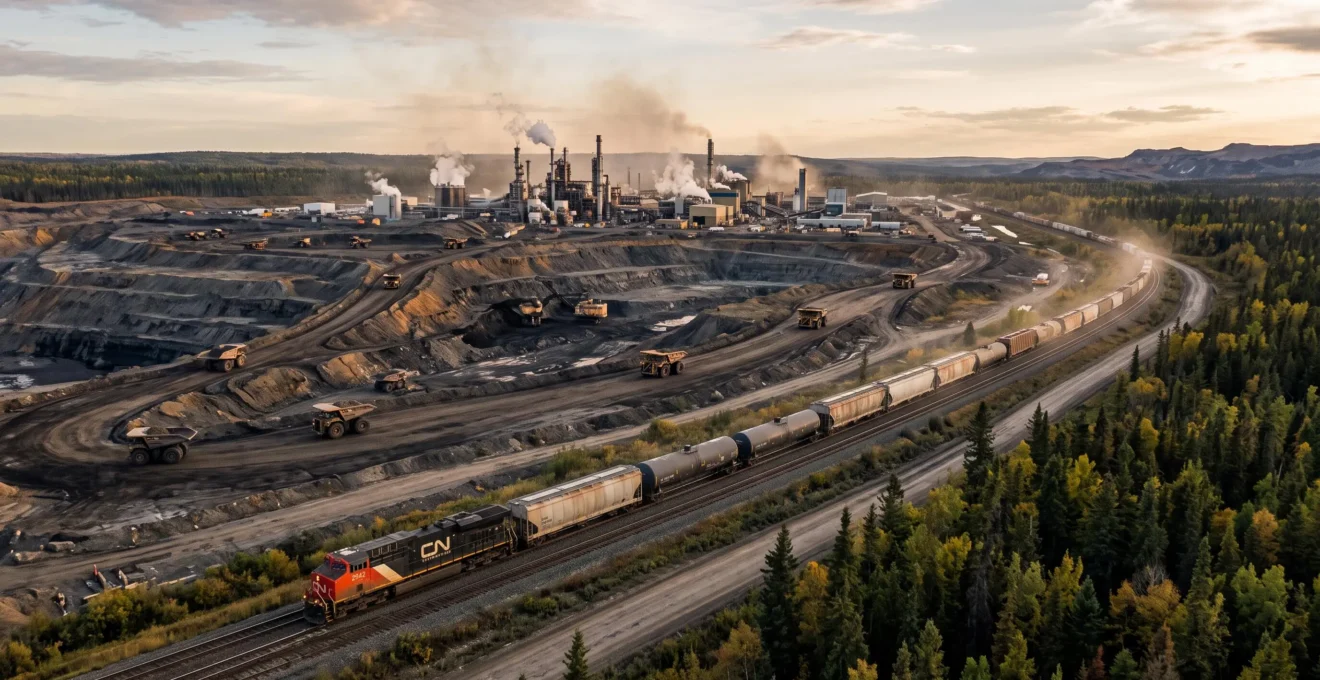
Natural resources remain strategic for the Canadian economy because they drive industrial activities, support regional jobs, generate exports, and influence infrastructure investments. Petroleum, natural gas, minerals, forests, and water resources thus contribute to the development of territories with vastly differing economic structures.
This importance extends far beyond extraction alone. A mine mobilizes transport companies, specialized equipment, and technical services. A forestry sector can combine logging, sawmills, manufacturing, and distribution. A hydroelectric project supplies electricity to households and industries, sometimes far beyond its region of production.
In 2024, production by the Canadian natural resources sector reached 716.5 billion Canadian dollars according to Statistics Canada indicators. This figure measures sectoral output, not its direct contribution to gross domestic product (GDP).
Understanding this economy therefore requires examining both the benefits of regional specialization, the risks tied to global markets, and opportunities for diversification.
Natural Resources in the Canadian Economy: The Essentials
- Resources shape regional economies based on geology, forests, waterways, and available infrastructure.
- Their contribution depends on an entire economic chain, but exposure to global prices leaves certain territories vulnerable.
- Local processing, industrial diversification, and hydroelectricity can strengthen regional resilience under specific conditions.
- Why is the economy of certain provinces still tied to natural resources?
- How does a natural resource move from extraction to export?
- Forests, minerals, or energy: which resources weigh heaviest by region?
- Why does a drop in commodity prices make certain regions vulnerable?
- When should a resource-dependent region diversify its economy?
- Why do certain Canadian territories possess strong hydroelectric potential?
- Forestry, mining, or tourism: which uses dominate the Canadian Shield?
- Why is hydroelectric energy so developed in several Canadian provinces?
Why is the economy of certain provinces still tied to natural resources?
Certain Canadian provinces maintain a strong specialization in natural resources because their territory possesses deposits, forests, or waterways favorable to their exploitation. These geographic advantages attract investment and encourage the establishment of specialized businesses. Gradually, local jobs, transportation, and services organize around these activities.
Geography is a decisive factor: unlike an easily relocatable activity, the exploitation of a mineral deposit depends on its location. The site of a forestry company is also influenced by the availability of harvestable stands, while a hydroelectric project requires appropriate hydrological conditions.
This relationship is documented by Statistics Canada’s analysis of nature and economic activity, published in 2025 using experimental geographic GDP estimates for 2021.
Specializations are visible in several provinces:
- Alberta: hydrocarbons occupy a structuring role in a portion of industrial activity and investment.
- British Columbia: forests supply processing industries and economic activities across multiple regions.
- Newfoundland and Labrador: mining and offshore hydrocarbons constitute major components of the resource economy.
These activities also support sectors that are not directly extractive: construction, industrial maintenance, transportation, food services, or professional services. A region can thus benefit from a network of businesses tied to the presence of a resource.
However, specialization does not necessarily mean excessive dependence. A province can possess a powerful energy industry while maintaining other economic engines. Conversely, a small community organized around a single mine can be far more vulnerable to a slowdown.
Dependence becomes concerning when employment, public revenues, and investment rely heavily on a single activity. Resource royalties can contribute to provincial budgets, but their importance must be examined within each province’s public accounts rather than deduced solely from production value.
This distinction helps explain why the presence of a resource can foster development without guaranteeing stability. The next step involves examining how this wealth circulates within the economy.
How does a natural resource move from extraction to export?
A Canadian natural resource reaches foreign markets through a value chain comprising exploration, extraction, potential processing, transportation, and commercialization. Each step mobilizes businesses, workers, and equipment. Profitability therefore depends not only on the available resource, but also on its quality, production costs, and market access.
This chain involves several complementary stages:
- Exploration: geological or technical work identifies a resource and evaluates exploitation possibilities.
- Extraction: the company mobilizes facilities, labor, and equipment to produce the raw material.
- Processing: the resource may be sorted, concentrated, refined, or transformed according to its nature and markets.
- Transportation: pipelines, railways, roads, electrical grids, or port terminals ensure its delivery.
- Commercialization: the resource or processed product reaches a Canadian or foreign customer.
Each stage possesses its own economic logic. Extraction specifically compensates labor and industrial investment. Processing can increase product value, but often demands costly facilities, energy, and additional skills.
Infrastructure plays a decisive role. A deposit remote from a rail network, port, or consumer market may entail logistic costs that reduce its competitiveness. In the energy sector, pipeline access influences routing possibilities. For minerals and forest products, the availability of land and maritime transport also constitutes a strategic issue.
Exports make these activities sensitive to international demand. Global prices, commercial conditions, and the concentration of export markets can influence the revenues of Canadian businesses. The proximity of the American market represents a logistical advantage in particular, but can also heighten exposure to shifts in bilateral trade relations.
To precisely measure the weight of resources in the trade balance, one must nevertheless distinguish gross exports, imports, and the trade balance. Domestic production alone does not establish these results.
This organization is not uniform, however: it depends on dominant resources and the economic characteristics specific to each Canadian region.
Forests, minerals, or energy: which resources weigh heaviest by region?
The weight of natural resources varies sharply across Canadian regions. Hydrocarbons structure part of the Western economy, forests support significant activities in British Columbia, minerals are present in several territories of the Canadian Shield and the North, while hydroelectricity occupies a major place in certain provinces. No single ranking summarizes these specializations.
Official indicators nevertheless allow differences to be measured. In 2024, according to Statistics Canada’s table on provincial natural resource indicators, Canadian production in the energy subsector reached 445.8 billion Canadian dollars, compared with 197.7 billion for minerals and mining, and 62.3 billion for forestry.
CAD 716.5 billion
Production of the Canadian natural resources sector in 2024, according to the consulted statistical series. This figure represents sectoral output, not value added nor direct contribution to GDP.
Statistics Canada, table 36-10-0624-01, 2024 data.
At the regional level, key specializations can be presented qualitatively:
| Region | Characteristic Resources and Activities | Economic Challenge |
|---|---|---|
| Alberta and Saskatchewan | Hydrocarbons, other energy activities, and agriculture | Investment, processing, and market access |
| British Columbia | Forests, minerals, and hydroelectricity | Forest processing, sustainable exploitation, and transport |
| Quebec and Manitoba | Hydroelectricity, forests, and mineral resources | Electrical supply, industrial development, and exports |
| Canadian Shield and North | Minerals, forest resources in suitable zones, and energy activities | Remoteness, infrastructure, and operating costs |
| Atlantic Canada | Fishing, forestry, mining, and offshore hydrocarbons depending on provinces | Coastal economy, processing, and market sensitivity |
These profiles do not mean a resource necessarily dominates the GDP of an entire province. They describe significant specializations whose real weight depends on the chosen indicator.
Four indicators must be distinguished to assess a resource’s economic importance: its contribution to GDP, its share of employment, resulting public revenues, and its contribution to exports.
This distinction becomes essential at the local level. A mine may represent a small fraction of provincial GDP while remaining a critical employer for an isolated community. Mining towns such as Sudbury in Ontario or Val-d’Or in Quebec illustrate the historical importance of these activities, even if their economies are no longer limited to a single industry.
National averages therefore provide an incomplete view of regional realities. Specifically, they may mask the vulnerability of communities heavily exposed to international market fluctuations.
Why does a drop in commodity prices make certain regions vulnerable?
A drop in commodity prices makes specialized regions vulnerable because it reduces the economic value of their production and can diminish businesses’ anticipated revenues. Investments then become less attractive, certain projects are postponed, and employment may undergo adjustments. Effects often extend beyond the extractive sector to impact the local economy.
Canadian producers do not unilaterally determine international prices for oil, gas, or metals. These depend notably on supply, demand, and global trade conditions.
When a price declines, companies may seek to reduce costs, review projects, or limit certain expenses. However, consequences are not automatic: they depend on initial profitability, contracts, operating costs, and the duration of the downturn.
Balance-sheet data illustrate this sensitivity. According to official statistics on Canada’s natural resource wealth, the value of evaluated natural assets fell from CAD 1,520 billion in 2023 to CAD 1,362 billion in 2024.
Statistics Canada primarily attributes this decrease to fluctuations in global commodity prices rather than an equivalent contraction in physical stocks.
Approx. −10%
Variation in the value of selected natural assets between 2023 and 2024. This asset decline does not correspond to a 10% drop in GDP, employment, or physical production.
Statistics Canada, Canada’s natural resource wealth, 2024; preliminary estimates published in November 2025.
Transmission to the regional economy can subsequently take several forms. A slowdown in industrial orders affects subcontractors. Workforce reductions weigh on commerce and services. Suspended investments curtail activity for certain construction or transportation companies.
Public finances may also be impacted when royalties, taxes, or certain revenues depend on the sector’s performance. The magnitude of the effect must nevertheless be assessed using budget data specific to each administration.
Above all, one must distinguish a cyclical shock from structural vulnerability. A temporary price drop may trigger a slowdown followed by a recovery. The depletion of a deposit, the obsolescence of a facility, or a lasting decline in demand pose much deeper problems.
This exposure does not imply that a region should abandon its resources. Rather, it indicates why diversification becomes a long-term economic question.
When should a resource-dependent region diversify its economy?
A resource-dependent region should initiate its diversification before a lasting decline in its primary activity jeopardizes employment, local businesses, and public finances. Timing becomes particularly important when multiple indicators signal high concentration or deteriorating prospects. Diversification is best prepared during periods of favorable activity rather than in crisis situations.
The goal is not necessarily to replace an industry that remains competitive. Instead, it consists of developing other economic outlets to reduce the consequences of production drops or market shifts.
Several signals can justify heightened attention:
- A large share of local jobs depends directly or indirectly on a single employer or sector.
- Public revenues rely heavily on the exploitation of a particular resource.
- Facilities are aging and require major investments to continue operating.
- Prospects for global demand or resource availability become uncertain.
- Local skills and infrastructure are difficult to mobilize in other sectors.
None of these indicators alone defines a universal threshold of dependence. Their combined evolution is generally more instructive.
Possible strategies depend on existing strengths. A mining region may pursue greater local processing, develop technical services, or leverage its workforce’s skills. Certain industrial competencies may be transferable to geothermal energy, energy equipment, or battery mineral value chains, provided demand and projects are economically viable.
Tourism, higher education, and specialized services constitute other avenues when the territory possesses suitable assets.
Concretely Assessing a Region’s Need for Diversification
- Measure employment concentration: produce a breakdown table of local jobs by major sector.
- Examine public finance exposure: establish a sheet detailing resource-related revenues and their evolution.
- Map vulnerable activities: identify key businesses, their suppliers, and the infrastructure they depend on.
- Inventory transferable skills: draw up an inventory of trades, training programs, and equipment mobilizable in other activities.
- Compare conversion possibilities: create a matrix presenting, for each envisioned sector, its investment needs, markets, and obstacles.
Diversification generally requires lasting coordination among businesses, communities, educational institutions, and public authorities. Its results also depend on external factors, such as access to capital and markets.
Finally, it must avoid a frequent error: considering all new activities as inherently profitable or creators of equivalent jobs. Successful conversion relies on viable projects rather than a mere multiplication of initiatives.
Hydroelectric energy precisely illustrates another way of leveraging territorial resources: it links a region’s physical characteristics to its industrial and energy development.
Why do certain Canadian territories possess strong hydroelectric potential?
Certain Canadian territories possess strong hydroelectric potential thanks to their river networks, elevation drops, and available water volumes. Quebec, British Columbia, Manitoba, and Newfoundland and Labrador present particularly favorable conditions for large-scale developments. However, abundant water resources only become an economic advantage with adapted infrastructure, financing, and operating conditions.
Hydroelectric production relies on converting water energy into electricity. Two physical parameters are essential: mobilizable flow rate and drop height. A river featuring significant flow or a favorable gradient can offer production possibilities, subject to technical and environmental constraints.
Canada’s major river basins explain part of this distribution. Geographic and hydrological conditions are notably described in Natural Resources Canada’s presentation of hydroelectric energy.
However, natural potential and production capacity are not synonymous. Building a dam or power plant requires studies, authorizations, investments, and transmission lines. Watercourse characteristics, competing uses, and ecosystem impacts strongly influence decisions.
Historical development has also played a decisive role. In Quebec, large hydroelectric projects and Hydro-Quebec’s standing helped structure an energy model combining provincial supply, industrial activity, and electricity exchanges.
In other provinces, physical potential was mobilized according to different configurations, particularly based on the location of consumption centers and interconnection possibilities.
Hydroelectricity differs from mining or petroleum extraction in its mode of production: it uses a water flow renewed by the hydrological cycle. Its revenues can exhibit a degree of predictability when production and sales contracts are relatively stable.
They are not guaranteed, however. Drought periods, hydrological variability, pricing conditions, and required investments can modify the economic results of installations.
These conditions take on a particular dimension in the Canadian Shield, a vast territory where mineral, forest, and hydraulic resources coexist with other uses.
Forestry, mining, or tourism: which uses dominate the Canadian Shield?
In the Canadian Shield, mining, forestry, and hydroelectric activities occupy an important place due to the territory’s geological and natural characteristics. Tourism and outdoor recreation also constitute economic activities across several regions. Their respective importance depends on accessible resources, infrastructure, climatic conditions, and planning choices.
The Canadian Shield spans a vast portion of Canadian territory. Its ancient geological formations host various mineral deposits, while numerous zones feature rocky terrain, lakes, and forests.
These characteristics create economic opportunities but also impose constraints. Soils poorly suited to certain forms of agriculture, remoteness from markets, and climatic conditions can limit feasible activities.
Mining exploitation concentrates around economically exploitable deposits. Gold, nickel, and copper feature among the characteristic resources of certain zones. The activity requires road or rail access, specialized equipment, and sometimes processing facilities close to extraction sites.
Forests constitute another major use in regions where timber stands and access conditions allow for economic exploitation. Forestry can supply sawmills, wood product industries, and transportation activities. However, it must be balanced with conservation objectives and forest ecosystem regeneration.
For its part, hydroelectricity leverages river networks when flow rates, drop heights, and implementation conditions are favorable.
Tourism brings a different economic logic: natural parks, water sports, hiking, hunting, or fishing can support accommodation, dining, and guiding services. Its development varies according to destination accessibility, seasonality, and visitor numbers.
These uses are not always compatible. Forestry operations can alter the recreational experience of a site, while a mining or hydroelectric project can transform the landscape, land access, and natural environments.
Indigenous communities occupy an essential place in these trade-offs. Rights, traditional uses, consultation obligations, and participation arrangements must be evaluated according to the specific territories and projects involved. The interests of different communities cannot be considered uniform.
Managing the Canadian Shield thus requires a territorial approach combining economic activities, environmental protection, and due consideration of existing rights and uses.
This diversity serves as a reminder that a resource is not merely a raw material: it also shapes planning choices and the economic organization of a territory.
Key Takeaways Before Evaluating the Economic Role of Hydroelectricity
- Significant natural potential alone does not guarantee the profitability of an energy project.
- Electrical grids, industrial demand, and commercial outlets determine a portion of the value created.
- Investment costs, environmental impacts, and the rights of affected communities must be factored into decisions.
Why is hydroelectric energy so developed in several Canadian provinces?
Hydroelectricity has expanded significantly across several Canadian provinces because it combines favorable natural conditions with renewable and generally low-carbon power generation during operation. Historical investments in dams, power plants, and transmission grids have made it possible to supply electricity to populations, support specific industries, and drive commercial trade.
Its economic appeal rests primarily on its cost structure. Constructing a major project mobilizes significant capital, but fuel expenses are non-existent, and operating costs can remain relatively low once the facility is in service.
This advantage must be evaluated over the entire lifespan of the project. Financing, maintenance, refurbishment work, and environmental impact management represent costs that can be substantial.
Power plants with reservoirs also offer operational flexibility: subject to their hydrological and operational constraints, they can adjust their output to match grid demand. Not all hydroelectric facilities possess the same storage or regulation capacity, however.
This flexibility takes on particular importance in a power grid integrating greater shares of variable generation, such as wind and solar power.
Hydroelectricity can also foster industrial development. A large and competitive electricity supply can serve as an attractive factor for energy-intensive activities, notably aluminum smelting and certain processing industries.
Provinces do not pursue identical objectives, however:
- Some primarily leverage their production to meet domestic demand and support local industry.
- Others also use their generation capacity and interconnections to sell electricity to external markets.
- Provinces with fewer water resources may rely more heavily on other generation methods or electricity imports.
Exports can generate revenue, but these depend on contracts, market prices, available quantities, and grid capacity. They should not, therefore, be viewed as systematically stable.
Hydroelectric development also raises major challenges. Large projects require extensive study and construction timelines, long-term financing, and thorough assessment of their effects on rivers, habitats, land, and surrounding communities.
The renewable nature of this energy does not eliminate its environmental impacts. Reservoirs can alter ecosystems and cause greenhouse gas emissions in certain situations. Effects on traditional uses and Indigenous rights must also form part of the evaluation.
In the context of electrifying transportation, buildings, and certain industrial activities, hydroelectricity nevertheless represents a major asset for provinces that already possess adapted facilities and networks.
Its future expansion will depend on balancing demand, existing capacity, new project costs, security of supply, and social and environmental acceptability.
To better appreciate the role of natural resources in Canada, the most useful approach involves comparing provinces using multiple indicators: GDP, employment, exports, public revenue, and economic diversity. This reading helps distinguish territories that benefit from a competitive specialization from those needing to strengthen their economic resilience.
What is the difference between the value of natural resources and their contribution to Canadian GDP?
The value of natural resources can refer to the estimated worth of available reserves or stocks. Contribution to GDP, meanwhile, measures value added created over a given period. Sectoral production represents yet another indicator. These metrics are not interchangeable and must be compared within identical statistical parameters.
Is a province rich in natural resources necessarily more prosperous?
No. Resource abundance can encourage investment and exports, but prosperity also depends on productivity, infrastructure, workforce, institutions, and economic diversification. A mineral-rich region can experience hardship if operating costs are high or market conditions turn unfavorable.
Why can a mining town be more vulnerable than an entire province?
A small community may concentrate a significant share of its jobs and services around a single facility. Its closure or slowdown consequently affects multiple local businesses. On a provincial scale, the existence of diversified economic sectors can limit the relative impact of the same event.
Do renewable resources protect regions from economic fluctuations?
Not entirely. Forests and hydro energy rely on renewable resources, but their operational activities remain exposed to demand, natural conditions, financing costs, and operating constraints. Their renewable nature guarantees neither constant revenues nor protection from economic risks.
Which indicators should be consulted to compare the weight of natural resources across provinces?
At a minimum, one should examine contribution to GDP, employment, production, exports, and resource-related public revenues. Statistics Canada’s provincial indicators allow for several of these comparisons. To assess remote communities, complementary local data are required.